
Church Life
2026: The year of experiments
What does it look like to live out our Matthew 11:28-30 vision in 2026? We’re glad you asked…

•

Back in January 2023, we sat in our living room with a small group of people we’d met around Toowoomba and first pitched the idea of a church shaped around Matthew 11:28–30. We asked some simple but important questions: What if there was a church that cared less about how many people turned up on a Sunday and more about the formation of their character? What if we could be less focused on polished services and more attentive to the culture we’re forming? What if, instead of people (and pastors) burning out under a relentless schedule of church activity, we actually experienced the deep, soul-nourishing rest Jesus invites us into in Matthew 11?
Within a few months of leaning into that vision, we realised that planting a church around rest is very much an uphill climb. When you start a new church, best practice suggests you want buzz, momentum, and tangible energy. And yet, three years on, it feels like we are exactly where we are meant to be, putting down deep roots and discovering a different way of sharing life together as a church.
Revisiting our why… and our what
On Sunday, we took some time to revisit our vision and ask the big ‘why’ questions about Toowoomba Vineyard Church. I’m not going to rehash that here. You can listen to the podcast or read the short version on our vision page.
At the same time, we recognise that we have probably spent less time than needed describing the practical side of that vision. If we are going to live out Matthew 11:28–30 together, what does that actually look like? What are the weekly, monthly, and annual rhythms that shape a shared life with Jesus?
Our starting place is simple. Jesus does not invite us to just believe his teaching. He invites us to practice it. He makes this clear at the end of the Sermon on the Mount, where he compares teaching without practice to a house built on shaky foundations, and teaching put into practice to a house built to withstand the storm. The same idea is there in Matthew 11:28–30. The image is not rest found by sitting at Jesus’ feet and absorbing information. It’s apprenticeship. It’s learning to walk alongside him and participate in his work.
With that in mind, 2026 will be focused on learning to practice the way of Jesus together. We’re dubbing it the ‘year of experiments’ because we want to try a bunch of new ideas. Some of them may fail. But we also expect to discover surprising and beautiful ways of living life in community with Jesus at the centre.
What’s in store for 2026?
With no further ado, here are some of the experiments we have in mind.
Our calendar
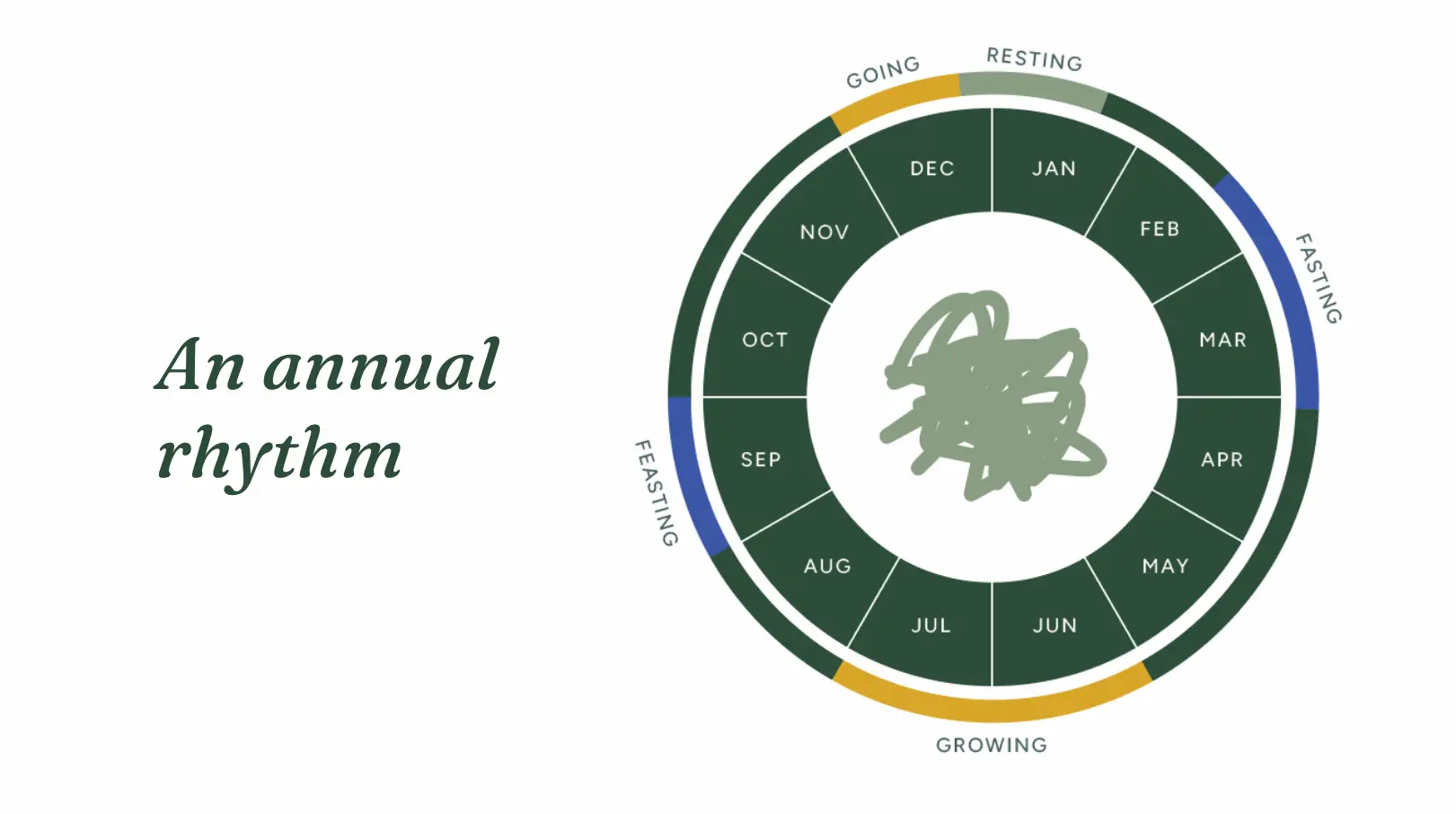
Even as we’re trying to put Jesus’ teaching into practice, it’s easy for church to become a series of disconnected Sundays. The church calendar was originally a way of forming people over time, helping them inhabit the story of God rather than just hear about it. We’ve noticed that our own community here in Toowoomba already experiences the year in seasons. Some months feel slower and more inward. Others feel exciting and outward. So instead of treating that as a problem to solve, we’re going to organise our year around it. By shaping the year around six core practices (fasting and feasting, going and growing, rest, and regular time), each held in tension with its opposite, we’re inviting the church into a shared journey. It gives us a common rhythm, a sense that we’re moving through something together, rather than each week standing alone.
Shared experiments
That raises an obvious question: what do these seasons actually look like? Our answer is shared experiments. Most of us have been formed to think about spiritual growth as a private project, something we do on our own with the church offering encouragement from the sidelines. The experiments flip that around. They are time-bound, collective (and optional!) practices that invite us to live out Jesus’ teaching together. Think last year’s ‘Advent Calendar of Kindness’.
With lent only a couple of weeks away, our first experiment will be called Give40. During the forty days of Lent, the invitation is to sell or give away one thing you own for each day. It’s anchored in the practice of simplicity and creates space to practice generosity along the way. Most of us have far more than we need, and this is a chance to fight back against the default mode of materialism. Together.
In contast, in September (as spring arrives) we’ll try an experiment called 100 Tables. Each time someone from our community shares a meal with someone else, they take a photo at the table. The goal is simple: reach 100 tables by the end of the month. It’s an experiment in feasting, hospitality, and paying attention to the ordinary places where community forms.
Teaching
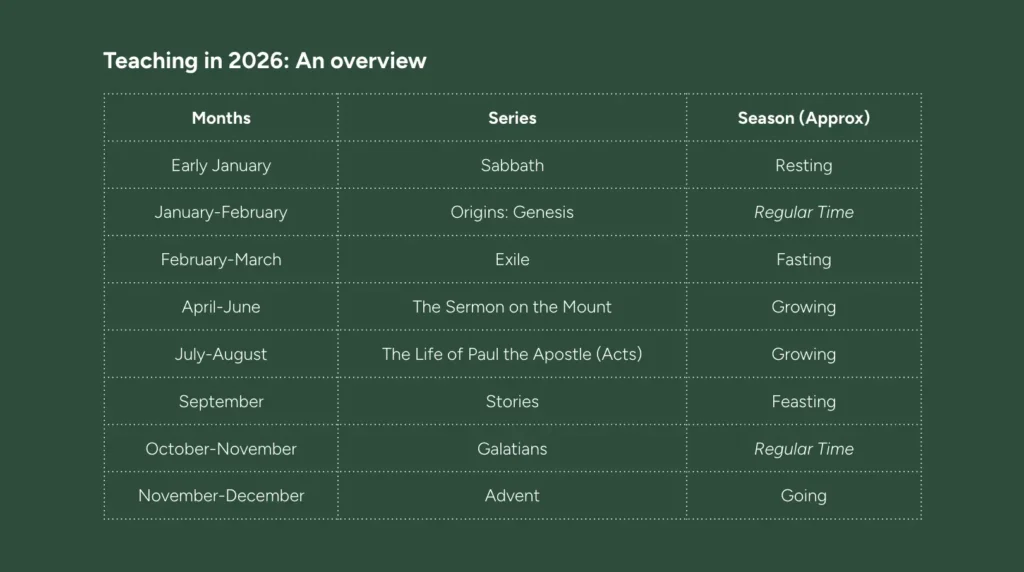
Across the year, our teaching will tell the story of Scripture as a whole — from creation, through Israel and Jesus, and on to the anticipation of new creation in advent. It gives us a healthy balance of topics and themes, and it roughly aligns with the seasons and practices we’ve proposed above. This year we’re using exile as a lens through which to view the story, but each year we could come back with a different emphasis.
Small groups
Being honest, small groups have been tricky to get off the ground. And yet we believe they can be so beneficial, creating another touch point during the week to foster community and shared growth.
Early this year, we want to trial a new format that’s deeply connected to our teaching and weekly practices We’re hoping we can find 8-10 people who would commit to giving this a go, and providing feedback along the way. Assuming this goes well, we’d like to have two healthy small groups by the end of the year.
Kids
When it comes to kids, we don’t want to simply entertain them or keep them busy while the adults do the ‘real’ spiritual work. Their formation matters just as much as ours. At the same time, kids ministry is tough, especially when it relies heavily on volunteers. One of our hopes is to bring on a paid helper to take some pressure off our volunteer base and create a more sustainable rhythm. In the meanwhile, it would be amazing to find 2-3 more people who could offer one Sunday a month to invest in our smaller people.
Finances
All of this raises the obvious question: how do we fund it? Our regular giving covers much of what we need, but there is still a gap. That gap is significant, but it’s intentional. Last year we shifted out of pure preservation mode. With a solid financial base, we decided to invest in growth rather than simply hold on. We are trusting that growth will come and that God will provide. If nothing changes, we have enough runway to continue for 12 months — which gives us space to act in faith, but not to become complacent.
Our invitation
So where do you fit in all of this? Our primary invitation isn’t first about filling roles or meeting budgets. It’s an invitation to take your own spiritual growth seriously. To actually commit to the practices we’re sharing week by week. To give the experiments a real go rather than a polite nod. To join a small group if you’re able, and to show up fully when you do. To sing with your whole body when we sing. And beyond any of that, to invest deeply in your faith in whatever way leads you closer to Jesus and more alive as a person.
Out of that kind of commitment, some practical needs naturally follow. We do need help, particularly with kids, where volunteers make an enormous difference. Giving also matters. We’re not interested in telling anyone what they should give, but we are inviting consistency, especially if this community is your spiritual home. And if you have friends who you think would benefit from this kind of church, one of the simplest ways to support what we’re doing is to bring them along.
Above all, we need prayer. While there are some good ideas here (we like to think, anyway), transformation doesn’t come from good programs. Deep, inner transformation happens through the work of God’s Holy Spirit. So we’d ask that even as you read this, you’d partner with us in prayer to see the Kingdom come in our church and our city.
Onwards, together!
More posts
A prayer for our enemies
In an increasingly divided world, praying for our enemies is a profound act of resistance. Here’s a helpful framework.

What is Christian Fundamentalism? A brief overview, and how to respond in love
As a church, we talk a lot about transforming culture. But to transform something, we first have to understand it.

All about kids church at TVC
At Toowoomba Vineyard Church we have a heart for our littlies and want them to enjoy the teachings and fellowship of church just as…
How to connect
Are you looking for a church to call home? Want to learn more about Jesus or Christianity? We’d love to connect. You can get in touch at the link below, or visit us on Sunday.
Leave a Reply